

Already a member?
Sign inBecome part of the foremost online community!
Sign Up NowOr, download the The Glaucoma Community app on your phone


Learn how minimally invasive glaucoma surgery (MIGS) works, who may benefit, and how it compares to traditional glaucoma treatments for lowering eye pressure and preserving vision.
Technology keeps getting smaller—and in glaucoma care, that’s a good thing.
Over the past decade, ophthalmologists have developed microscopic surgical devices, some about a millimeter wide, to help lower eye pressure. This approach is called minimally invasive glaucoma surgery (MIGS). For people with mild to moderate glaucoma, MIGS may offer a less invasive way to help protect vision.
At the John A. Moran Eye Center at the University of Utah, glaucoma specialists use MIGS as part of a personalized treatment plan designed around each patient’s unique needs.*
Glaucoma is a group of eye diseases that damage the optic nerve, the structure that carries visual information from your eye to your brain.
In many cases, glaucoma happens when fluid inside the eye doesn’t drain properly. As fluid builds up, pressure inside the eye increases. Over time, that pressure can damage the optic nerve and lead to permanent vision loss.
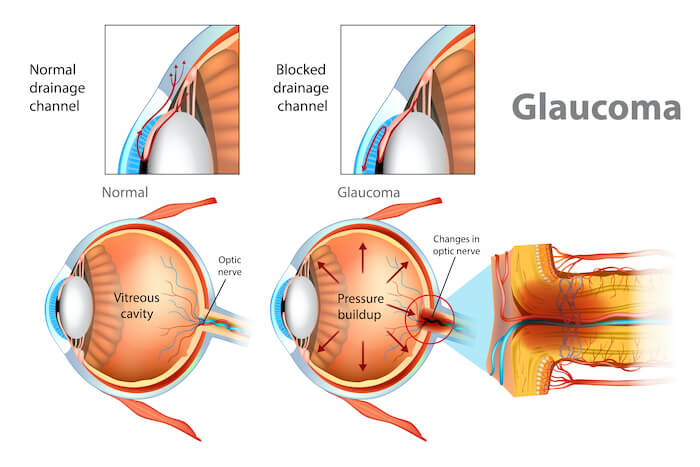
Graphic source: Dupage Eye Associates
“Once optic nerve damage occurs and vision is affected, we unfortunately can’t reverse it,” explains Roya Garakani, DO, a glaucoma specialist at the Moran Eye Center. “This is exactly why catching the disease early, lowering eye pressure, and keeping it controlled is so vital to protecting your sight.”
Because glaucoma often develops slowly and without noticeable early symptoms, regular comprehensive eye exams are essential.
There are several ways to treat glaucoma, depending on the type and severity of the disease. These include:
MIGS refers to a group of newer surgical procedures that use very small incisions and tiny devices to improve how fluid drains from the eye. The goal is to lower eye pressure while minimizing trauma to surrounding tissues.
Compared with traditional glaucoma surgery, MIGS procedures typically:
“MIGS gives us an invaluable tool for managing glaucoma,” Garakani says. “It’s part of a more modern approach to glaucoma care, as research now shows us that earlier surgical intervention often preserves more vision.”
In many cases, MIGS can be performed at the same time as cataract surgery. Some MIGS procedures can also be done on their own.
Since the first MIGS device was approved by the FDA in 2012, multiple devices and techniques have been developed. This allows surgeons to tailor treatment based on a patient’s eye anatomy and type of glaucoma.
“MIGS isn’t the right choice for everyone,” Garakani says. “Our goal is always to choose the treatment that offers the best long-term outcome for the individual patient.”
Your ophthalmologist may discuss MIGS with you if you:
Your doctor will carefully evaluate your eye health and long-term vision goals before recommending surgery.
If you’re considering MIGS, it may help to ask:
Glaucoma is a lifelong condition, but today’s treatment options are more advanced, and more personalized, than ever before.
MIGS represents an important step forward in glaucoma care. For the right patient, it may help lower eye pressure with less disruption and faster recovery than traditional surgery.
If you’ve been diagnosed with glaucoma or are struggling to control your eye pressure, talk with your ophthalmologist about whether MIGS could be part of your treatment plan.
*University of Utah Health. (February 13, 2026). “All About MIGS: The Latest Option for Managing Glaucoma”. healthcare.utah.edu
The information provided by The Glaucoma Community is for educational purposes only and does not replace professional medical advice. Always talk with your healthcare provider before making changes to your treatment or care. The Glaucoma Community does not endorse specific treatments, providers, or products.
Source: {{articlecontent.article.sourceName}}
Receive daily updated expert-reviewed article summaries. Everything you need to know from discoveries, treatments, and living tips!
Already a Responsum member?
Available for Apple iOS and Android


We've sent a report to our community managers who will take the necessary steps. This member will be removed form your Community Chat and will no longer be able to message you.
Please contact us if you have any questions.
Add Comments
Cancel